Bonde la Ufa — the valley of the crack
The Great Rift
West of the crater, the land drops into the Rift and the tour buses stop. What lies beyond is an abandoned irrigation city, an active volcano the Maasai call the Mountain of God, communities who have lived here for centuries, and a soda lake the colour of rust. Almost no one sells this route. We think it is the most honest week in Tanzania.
Why it is empty
There is a reason you will not find this route in most brochures, and it has nothing to do with it being unremarkable. The roads are rough. The lodges are few and simple. It does not slot into a seven-day Serengeti package, and there is no lion guaranteed at the end of it.
For an operator moving volume, that is a problem. For a traveller who has begun to suspect that the famous circuit is showing them a curated strip of a much larger country, it is the answer.
You will see other vehicles here perhaps twice in a day. You will also be somewhere that genuinely does not perform for visitors, because so few come.
The route, north along the valley floor
Engaruka — the city that farmed the desert
Several centuries ago, a large community built a stone irrigation system here that channelled water off the escarpment across terraced fields feeding thousands of people. Then it was abandoned, most likely as the water failed. The furrows and field walls are still there, running for kilometres across the slope.
Almost nobody visits. It takes about ten minutes among the stones to feel the assumption quietly collapse — that this landscape has no history but wildlife.
The communities of the Rift floor
The Maasai here are not a roadside attraction. They are living on the land, moving cattle, managing water, dealing with a genuinely difficult environment.
Where a community has agreed to receive travellers, we arrange it on their terms — a real homestead, a real day, fairly paid and openly explained. No staged dance, no arranged photograph. If it cannot be done that way, we do not do it, and we will tell you why.
Ol Doinyo Lengai — the Mountain of God
A perfect ash cone rising nearly three thousand metres from the valley floor, and the only active carbonatite volcano on earth — its lava is cool enough and strange enough to run black, then turn white in the sun.
To the Maasai it is Oldoinyo Le'engai, the mountain of the deity. Climbing it means starting around midnight, on steep ash and loose rock, to reach the crater at first light. It is one of the hardest nights we arrange, and we are frank about that before you commit.
Lake Natron — the end of the road
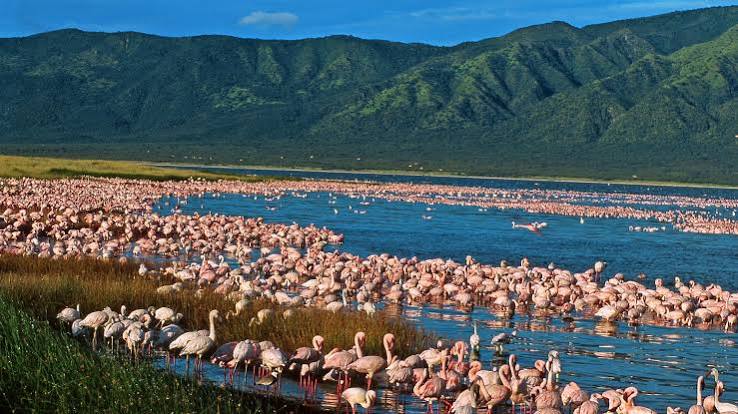
A shallow soda lake at the bottom of the Rift, hot, mineral, and stained red and rust by the microorganisms that thrive in it. Almost nothing else survives there — which is precisely why nearly all of East Africa’s lesser flamingos come here to breed. It is the single most important flamingo breeding site on the continent.
Behind it, the Engare Sero gorge holds waterfalls and cold pools, which after a day in that heat is the most welcome thing in Tanzania. Nearby, a set of ancient human footprints sits preserved in the ash.
What it asks of you
We should be plain about this. The driving is long and rough. The heat at Natron is serious. Accommodation is simple — good tented camps rather than lodges with pools and spas. There is no guarantee of big cats, because this is not that kind of country.
What you get instead is a week in which almost nothing has been arranged for visitors, because visitors barely come. The Rift does not perform. It simply continues, and you are briefly inside it.
If your week must include the crater, the migration and a beach, this is not your route. If you have begun to want the opposite of that, it may be the only one.
How we compose it
This route lives or dies on the guide. A driver who knows the road can get you to Natron; someone who grew up in the Rift can tell you why the Engaruka furrows run where they do, what the cattle are doing, and which household would genuinely welcome an afternoon guest.
So we use location-specific guides from the communities along the valley, paid properly, named to you in your proposal. On the mountain, the same commitments hold as on Kilimanjaro: fair wage, fair load, proper gear.
Four to six days does it well. It pairs naturally with the crater on the way in, or the Serengeti afterwards — and for anyone climbing Lengai, it makes serious sense before Kilimanjaro rather than after.
Can you climb Ol Doinyo Lengai?
Yes, and it is genuinely demanding. The climb starts around midnight to reach the summit at dawn and avoid the heat; it is steep, loose underfoot, and takes most people five to seven hours up. It is not a walk. We will tell you honestly whether it suits your fitness rather than sell it to you.
Is Lake Natron safe to visit?
Yes, with sense. The lake is highly alkaline and extremely hot in places — it is not for swimming or wading. The area is remote, the roads rough, the heat serious. With a guide who knows the ground it is entirely manageable, and the waterfalls in the Engare Sero gorge are a genuine relief.
What is Engaruka?
The ruins of a large farming settlement, several centuries old, built around a sophisticated stone irrigation system that carried water from the escarpment across terraced fields. It was abandoned, probably as the water failed. Almost no visitors go there, and it quietly upends the idea that this landscape has no history of its own.
How is time with Maasai communities arranged?
On terms the community sets, fairly compensated and openly explained. We do not arrange staged dances or arranged photographs. If it cannot be done honestly, we do not do it.
When is the best time for the Rift route?
June to October is driest and the roads are most reliable. The flamingo breeding at Natron is seasonal and depends on water levels, so it is never guaranteed. We avoid the height of the long rains, when the tracks to Natron can become genuinely difficult.
Often composed alongside
If this sounds more like what you were hoping Tanzania might be, tell us. We will be honest about whether it suits you.
Begin a conversation →